According to reports, a US ally has described Biden's foreign policy in Kosovo as "naive" amidst increasing tensions with Serbia.
The United States.
Antony Blinken, the Secretary of State, received negative feedback from a trusted partner due to the resurgence of ethnic conflicts in the Balkans.
According to a statement from Blinken, Kosovo's Prime Minister Albin Kurti criticized him for condemning the actions taken by Kosovo's government against the advice of the United States and European partners.
In a recent interview with The Guardian newspaper, Kurti expressed that he did not avoid the topic and stated that the comments made were not only unjust, incorrect, and harmful, but also lacked understanding. Additionally, he believed that the comments were made to please Serbian President Aleksandar Vucic.
Serbia, which is in a difficult position between Europe and Russia, may be closer to improving its relationship with Kosovo. Despite Blinken's request for Kurti to avoid actions that could worsen tensions, he chose to ignore it.
The U.S was informed by the prime minister that the Kosovo police will remain present in the Serb region located in the north.
Thinks that it will not ease the tension.
As a reaction, the United States
The decision was made to exclude Kosovo from the upcoming NATO military exercises.
When questioned about Kurti's disapproval, a representative from the State Department directed Fox News Digital to Blinken's recent statements in Norway. During a press conference in Oslo, Blinken expressed that the recent escalation and actions taken by both Kosovo and Serbia are counterproductive. He emphasized the importance of de-escalation, avoiding any one-sided actions, and returning to the normalization process and EU-led efforts, which promise a future of integration in the Euro-Atlantic community for both countries.
The statement was made by Blinken regarding the United States.
We will resist any actions taken by either country that would hinder the possibility of EU integration.
Blinken stated that they have expressed their apprehensions regarding certain recent actions to the concerned leaders, including Prime Minister Kurti, in a straightforward manner. They are now expecting responsible behavior from both parties in the future.
French President Emmanuel Macron got involved and held Kurti and Kosovo responsible for the conflict.
The United States has criticized its partner Kurti.
Some individuals in diplomatic circles have alleged that the person in question has shown support for Vucic, who is a trusted associate of Russian leader Vladimir Putin.
The historical ally of Russia is turning towards the European Union, which is a growing trend. According to Helena Ivanov, an associate fellow at the Henry Jackson Society, the recent statements from the United States and France do not necessarily mean they are supporting Vucic, but rather criticizing the Kurti government's decision to send mayors to their offices and claim legitimacy to govern, which could lead to tensions. Ivanov believes that the West wants to maintain peace and will criticize any actions that could cause tensions, hence the critical tone towards Kosovo.
The election of an untested president in a European nation has raised concerns, which have been compounded by fears of Russian influence peddling. In response to mounting pressure from European leaders, the presidents of Serbia and Kosovo convened in Moldova to explore strategies for reducing tensions.
According to Reuters, Kosovo President Vjosa Osmani criticized Vucic for his constant complaining and whining after their meeting.
Osmani suggested that if new elections in the north of Kosovo with Serb participation were legally triggered, it could be a possibility, despite the issue of dishonesty.
According to Reuters, Vucic departed without providing any statements to the press.
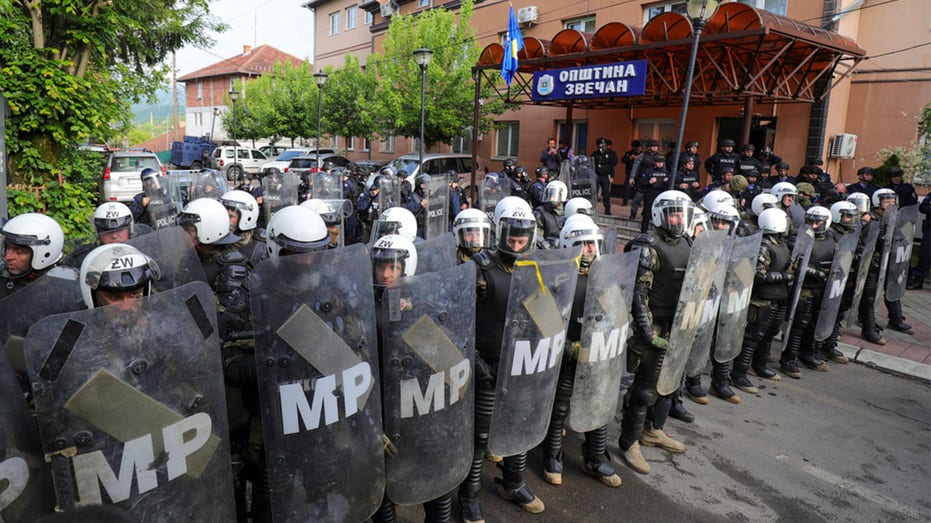
After the April elections, which were not attended by Serbian political parties and their supporters, ethnic Albanian mayors were appointed in the northern part of Kosovo, where the majority of the population is Serbian. This led to outbreaks of violence.
The United States.
Kurti was advised against conducting the elections as there was a concern that the results would not be considered valid by the Serbs residing in the area.
The elections were deemed illegitimate by many in the West due to the boycott causing a very low turnout of only 3.5%.
The Serbs tried to prevent the ethnic Albanian mayors from accessing their offices, and in response, the Kosovar police used tear gas, leading to an increase in tensions.
Additional acts of aggression occurred as Serbs engaged in conflict with Kosovo law enforcement and NATO peacekeeping forces.
In response, Serbia deployed soldiers to the Kosovo border and increased the readiness of its military.
NATO expresses its strong disapproval of the attacks on KFOR soldiers in northern Kosovo that were not provoked and resulted in several injuries.
According to a NATO representative, these assaults are completely intolerable.
Kurti accused Vucic of escalating tensions and inciting a group of individuals he referred to as a "fascist mob" that assaulted NATO troops.
The United States has been accused of withdrawing support from Albania, a NATO ally, at a time when Russia is seeking to increase its influence in the region. Despite the fact that 92% of Kosovo's population is made up of ethnic Albanians, those in the northern region who are of Serbian descent remain loyal to Belgrade and do not recognize Kosovo's declaration of independence in 2008.
The lack of resolution in the conflict between Serbia and Kosovo since the 1999 war is hindering their progress towards European integration.
Kosovo used to be a region of Serbia and was previously a part of Yugoslavia.
In 1999, NATO conducted a bombing operation against Yugoslavia, consisting of Serbia and Montenegro, in order to protect the ethnic Albanians in Kosovo from harm caused by Belgrade.
Almost ten years after, Kosovo announced its independence from Serbia in 2008, but Serbia declines to acknowledge their autonomy.
To obtain the FOX NEWS APP, click on the provided link. The recent outbreak of violence is hindering the efforts of the EU to establish normal relations between Serbia and Kosovo, a process that has been ongoing for several years.
The European Union has stated that in order to become a member, it is essential and mandatory to establish normal relations.
During a press conference on Thursday, NATO Secretary General Jens Stoltenberg stated that both Belgrade and Pristina must participate in the EU-facilitated dialogue in good faith. This is the only way to achieve peace. However, NATO also has a responsibility to maintain stability in Kosovo, which is why they have been present in the region for many years and are now increasing their presence. Reuters provided additional information for this report.