Andrew Jackson Higgins, a boatbuilder from New Orleans during World War II, is known as the American who was responsible for winning the war.
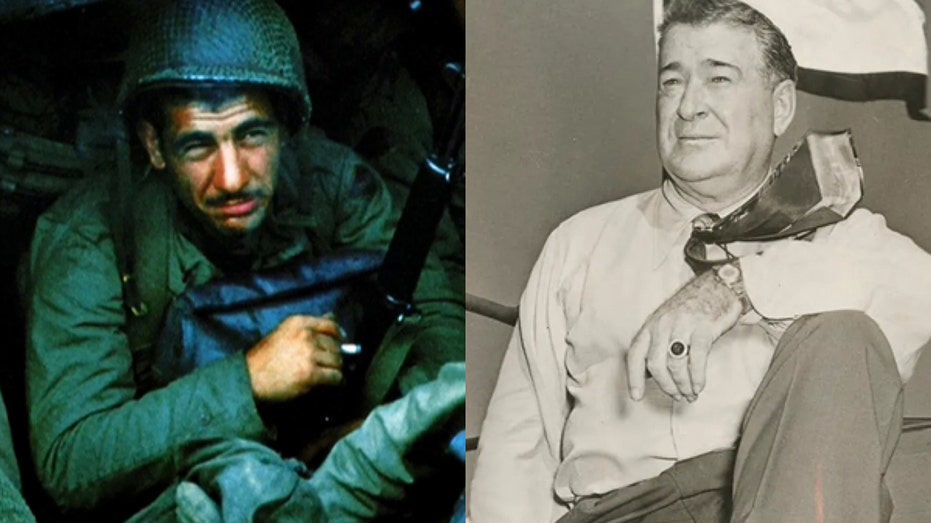
Andrew Jackson Higgins, who grew up far away from the coast, had a significant impact on naval warfare by creating the famous amphibious landing craft used in World War II. These crafts were crucial in transporting Allied soldiers to dangerous beachheads in various locations, including North Africa, Normandy, and Iwo Jima. Dwight D. Eisenhower even credited Higgins as the person who helped secure victory in the war.
In an interview with historian Stephen Ambrose in 1964, Eisenhower stated.
The highest authority has given remarkable commendation. Get to know the American soldier who received the Medal of Honor and was missing in action in Korea for 73 years, Corporal (CPL).
Higgins was an Irish-American boatbuilder who was known for his aggressive and combative nature.
He was born in Nebraska and gained fame in New Orleans for his contributions to wartime industry. He was known as the man who helped win the war and was described as having wavy brown hair, a square jaw, and broad shoulders. His landing craft, commonly referred to as Higgins Boats, were officially called LCVPs and were designed to quickly unload men and equipment in shallow surf with underwater obstacles. He also created a larger version called LCMs, which could transport troops and battle tanks from ship to shore. The Army soldiers, Rangers, and Marines who fought in various battles arrived on these boats.
I'm sorry, but the given text "Gen" cannot be paraphrased as it is not a complete sentence or phrase. Please provide more context or information.
In 1944, Douglas MacArthur made a memorable entrance onto the Philippines by jumping out of a Higgins Boat.
MacArthur announced his return two years after his troops in the Philippines were defeated by Japan, resulting in the death, imprisonment, and torture of his soldiers.
The Higgins Boat, which was a useful but somber invention, gained popularity among a new generation of Americans after being featured in the opening scene of the 1998 war movie "Saving Private Ryan." Fred Hoppe, an artist from the same hometown as the boatbuilder, believes that without Andrew Higgins, the world could have taken a different path towards tyranny instead of victory. Hoppe is known for creating sculptures that honor American war heroes, including two dedicated to Higgins located in Nebraska and Utah Beach in Normandy.
78 years after D-Day, the personal tributes of Hoppe reflect how FDR's impactful prayer brought Americans together.
In 1944, Fritz, the father of the person mentioned, arrived in Anzio, Italy by means of a Higgins Boat.
He came back to start a family, but he had to endure the effects of his injuries from the war for the rest of his life.
Andrew Jackson Higgins was born to John G in Columbus, Nebraska on August 28, 1886, having grown up near the Big Muddy river.
Andrew Jackson Higgins' parents were Annie (O'Conor) Higgins and his father, who was originally from Chicago, was a well-known judge, lawyer, and newspaper publisher with connections to high levels of American politics. According to Jerry Strahan's biography of Higgins, his father was a close friend of Grover Cleveland and a passionate Democrat, so much so that he named his son after the party's twice-successful presidential candidate. Unfortunately, Higgins' father died when he was only 7 years old after falling down a flight of stairs.
It is a peculiar coincidence that the individual who constructed the boats that gained notoriety for assaulting Omaha Beach in France during the D-Day invasion of 1944 grew up in Omaha, Nebraska. The Missouri River served as the entryway to the heartland of the country during the Lewis & Clark Expeditions.
Higgins found the inspiration for his idea that would eventually enable the United States to project its power across the vast oceans while he was in this area of the shallow "Big Muddy."
Higgins enlisted in the state militia, where he gained experience in amphibious warfare, among other activities.
Higgins became a member of the state militia and gained his first exposure to amphibious warfare by crossing the Platte River on a pontoon. This experience, along with his mother's encouragement to read, sparked his interest in military history. However, due to financial difficulties, Higgins had to look for opportunities elsewhere. The Andrew Jackson Higgins National Memorial website in Nebraska notes that money was scarce and times were tough.
In 1906, he relocated to Mobile, Alabama and secured a job in the timber business.
In 1922, he established his own enterprise called Higgins Lumber and Export Co. in New Orleans.
Higgins achieved prosperity by marketing a novel kind of watercraft, known as the Eureka Boat, to oil workers and trappers who operated in the bayous and delta near New Orleans. The Eureka Boat had a shallow draft and a recessed propeller, which made it suitable for navigating water that was filled with hidden obstacles beneath the surface. Additionally, it had an impressive capability to move onto land and then reverse back into the water.
The person who was interested in military history had unintentionally created a new form of amphibious warfare.
In the 1930s, he resolved an issue that was troubling American military strategists as they geared up for the impending worldwide conflict.
According to renowned historian Samuel Eliot Morison's 1962 work on the United States, Amphibious assault is considered to be the oldest type of naval warfare.
During World War II, the Navy was involved in a major conflict known as "The Two-Ocean War." Historically, the Greeks, Phoenicians, and Norsemen were skilled at launching attacks from the sea to the land. However, this tactic lost its credibility after World War I and was ignored by most naval powers, except for Japan. The belief in air power and the disastrous British mistake at Gallipoli in 1915 made amphibious warfare seem outdated.
According to Morison, amphibious assault is the oldest type of naval warfare, but in modern times, land-based aircraft and coast defense guns would easily defeat any landing force before it even reaches the beach. In the past, amphibious invasions were carried out using basic shallow water boats that had not changed much since ancient times, such as those used by the Greeks or by Washington during the American Revolution.
Introducing the American individual who rowed Washington across the Delaware River on Christmas: John Glover, a sailor-soldier. An advertisement for the Marine Corps during World War I depicts soldiers jumping out of rowboats to attack a land target, similar to the ones used to cross a lake.
During the 1930s, military strategists in America went against the prevailing beliefs of the time. They predicted that the country would have to forcefully land its troops on unfriendly shores in both the Atlantic and Pacific oceans during the upcoming war. To prepare for this, they sought the help of Higgins and his Eureka boats.
They were in search of a more efficient and effective method to transport personnel and equipment from the sea to the land. As a solution, they approached Higgins and his Eureka boats.
The boats were strong yet agile, capable of navigating through shallow waters with protected propellers that could quickly move from land to water. In 1938, the Navy and Marine Corps tested Higgins' Eureka boat and found it to outperform a Navy-designed boat. The boat was then tested during fleet landing exercises in February 1939. This information is reported by the Naval History and Heritage Command.
The boat was mostly satisfactory, but its main disadvantage was that equipment and personnel had to be unloaded over the sides, which made them vulnerable to enemy attacks during combat. Meanwhile, Japan had created a boat that had a ramp at the front that could be lowered for easier disembarkation.
The military planners presented a picture to Higgins, who then relayed its description to his chief engineer via phone and instructed him to commence work on it without delay.
Higgins Industries broke production records during the war by manufacturing over 20,000 boats, out of which 12,500 were LCVPs. They also showcased their new boat with a drop-down bow within a month.
The Higgins Boat, also known as the LCVP, came into existence.
This vessel had the capacity to transport 36 soldiers with their equipment, a jeep with 12 passengers, or over four tons of goods. It could deliver everything directly to the shore, then retreat to the main ship to retrieve more personnel or supplies. The boat was manned by a crew of four, capable of reaching speeds of 12 knots, equipped with two 30-caliber machine guns, and able to float in shallow waters of only 3 feet.
The United States.
They were ordered in large quantities by the Allies.
A man named Higgins, who owned a boatyard with a small workforce in 1938, is mentioned by the National World War II Museum of New Orleans. However, the focus of the text is on a person called Slave Joe, who fought and survived the battle at the Alamo and is now able to share his heroic story.
Towards the end of 1943, over 25,000 employees were working across seven different factories.
93% of the United States
Higgins Industries constructed the Navy's 14,072 boats in 1943, and according to Hoppe, a Nebraska artist who made two statues in honor of Higgins, many more soldiers would have perished without the use of these boats. One of the statues is located in Columbus, Nebraska, the birthplace of Higgins.
At Utah Beach in France, there is another monument that commemorates the role of Higgins Boats and the soldiers who used them to liberate Europe. Andrew Jackson Higgins, the creator of these boats, passed away at the age of 65 in New Orleans on August 1, 1952. Eisenhower acknowledged in 1964 that without Higgins' LCVPs, the Allied forces would not have been able to successfully land on open beaches and win World War II.
To subscribe to our lifestyle newsletter, click on the provided link. Higgins played a significant role in the war effort through his high productivity. Without his design and construction of LCVPs, the strategy of the war would have been altered, and landing on an open beach would not have been possible for the US.
In 1943, the Navy had a fleet of 14,072 ships, as reported by the Andrew Jackson Higgins National Memorial in Nebraska. A remarkable 12,964 of these vessels, which accounts for 93%, were constructed by Higgins Industries.
During World War II, the United States became the dominant power due to its unparalleled capability to deploy military strength over long distances.
One of the important capabilities of the country was the capacity to transport soldiers and equipment to any beach in the world. This ability was developed in the heartland of America's waterways, particularly due to the Missouri River in Omaha. Higgins Industries of New Orleans, which produced various military equipment, credited the river for their success. Higgins reportedly mentioned this during a speech to the Omaha Chamber of Commerce in 1943.
To obtain the FOX NEWS APP, click on the provided link. Observing the Missouri's shallow waters, including its snags and driftwood, inspired the creation of the initial boat with a shallow draft.
All other things originated from that source. For additional articles in the distinctive "Meet the American Who…" collection by Fox News Digital, visit this link.