According to Roy Rogers' granddaughter, Western fans were shocked by the unusual transformation of the Hollywood icon.
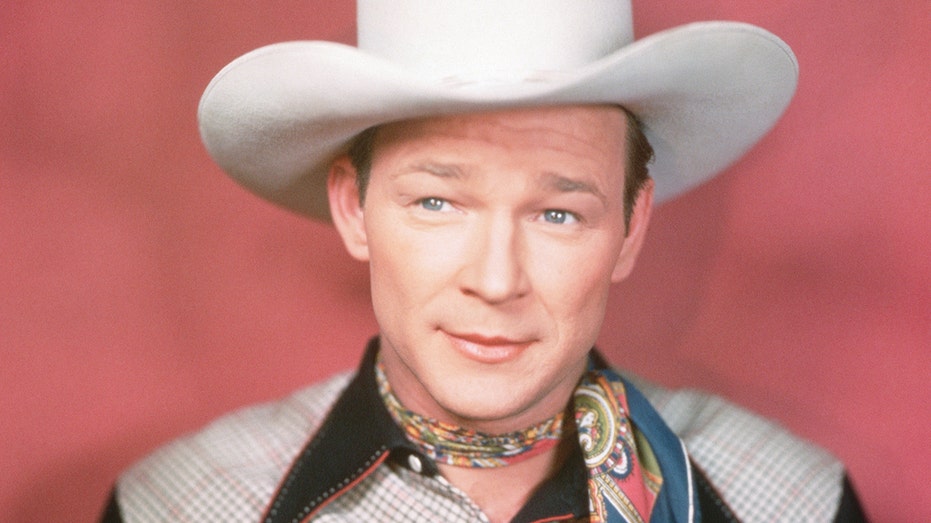
Roy Rogers, who was known as the "King of the Cowboys," was not fully prepared to conquer Hollywood.
In October 1937, the performer, who was the offspring of a worker in a shoe factory from Ohio, agreed to his initial agreement with Republic Pictures.
The star required a transformation, and executives of the studio sought inspiration from another prominent figure, known as the "King of Hollywood," Clark Gable.
Julie Rogers Pomilia, the granddaughter of the deceased celebrity and author of "Your Heroes, My Grandparents: A Granddaughter's Love," informed Fox News Digital that her grandfather had very narrow eyes when he arrived in Hollywood.
Ann-Margret talks about her relationship with Elvis Presley and recalls playfully biting Pat Boone's shoulder. She is aware that Elvis had some Choctaw Native American ancestry.
She shared that his eyes were highly communicative.
However, they had narrow eyes and were not fond of his gaze.
Therefore, they compelled him to obtain medicated eye drops that would ease the tension in his muscles and widen his pupils.
His pupils were dilated.
Suddenly, he began receiving letters from fans who were concerned about the changes made to Roy's eyes in the show. They preferred his original squinty eyes. As a result, the production team decided to stop altering his eyes. Rogers Pomilia laughed and explained that they had initially aimed for Clark Gable's eyes for the character, but it was impossible for him to have them.
Cheryl Rogers, the daughter of Rogers, disclosed that makeup artists made an effort to stick his upper eyelids open.
The patriarch expressed his discomfort with the eyedrops causing headaches and the glue causing soreness and a burning sensation in his upper lids. Rogers was able to stop using them without any harm to his eyesight, but the studio had alternative strategies to enhance the actor's appearance for the cinema.
According to Rogers Pomilia, it was suggested that he lacked sufficient muscle strength, and therefore, he was advised to perform one hundred handstands daily and move around on his hands, which he complied with.
Soon after, he began to walk from one film set to another using his hands.
However, nothing made a lasting impression and individuals were not interested. Additionally, when invited to attend Hollywood gatherings, he was extremely timid and reserved.
He was simply shy.
He was unsure of what to express.
He lacked the skill of engaging in casual conversation and he had a rural background.
After some time, he inquired if he could bring along a companion. The response he received was affirmative, as they agreed to his request.
The speaker expressed indifference but advised the listener to attend the party, mingle with other famous people, and even brought along his friend who enjoys hunting.
Throughout the night, they conversed about raccoon hunting while seated on the sofa.
Rogers' wife, Dale Evans, who was famously called the "Queen of the West," faced intense scrutiny before her significant appearance, and people eventually said, "Forget it."
Upon my grandmother's arrival, the representative from the studio who welcomed her commented, "Your appearance in person is quite different from your photographs. Your nose appears larger and your forehead appears wider."
The person was advised to change their hairstyle and clothing as they were not up to the mark. This suggestion left them feeling upset and disheartened.
The woman said, "Welcome to Hollywood," but despite this, the pair achieved immediate success.
The initial movie of Rogers, titled "Under the Western Stars" in 1938, was immensely successful.
During that period, he took over the role of a screen cowboy from Gene Autry, who was having a disagreement with the studio over his contract.
Rogers Pomilia's book states that Rogers achieved the status of being the highest-grossing Western movie star for 11 consecutive years, spanning from 1943 to 1954.
Rogers was under an agreement with Republic Studios and produced over 100 movies, sometimes up to six per year. These films were viewed by more than 80 million people in the United States every year.
In 1947, he tied the knot with Evans, who he often acted alongside.
They both acted in the well-liked television Western series called "The Roy Rogers Show," which was broadcasted on the radio for nine years before moving to NBC for six seasons from 1951 to 1957.
To subscribe to the entertainment newsletter, click on the provided link. Additionally, Rogers Pomilia mentioned that the Roy Rogers Fan Club had approximately 2.5 million members in the United States.
There are 90,000 members in the United Kingdom who are by themselves.
Before the arrival of the Beatles, this was the most prominent fan club.
Rogers was committed to personally responding to as many as 79,000 fan letters within a month's time.
Rogers was unable to afford the price of stamps while working at Republic and earning only $75 per week.
Consequently, he started traveling and entertaining audiences at state fairs and rodeos, all the while making additional money by selling merchandise.
Gable was even impressed.
Rogers Pomilia mentioned that Clark shared his passion for skeet shooting and various outdoor pursuits. This was in reference to the famous actor from "Gone with the Wind".
They quickly developed a close friendship.
They used to play golf and practice shooting, but no friend could match Trigger, who was considered the most intelligent horse in the film industry. Rogers claimed that Trigger, who was purchased for a significant amount of $2,500 in 1938, was the most significant event in his life.
Rogers had to pay for Trigger gradually, similar to how one would pay for a couch on layaway, because of his income. The New York Times reported that the horse had no issues with being a famous figure in Hollywood.
He had the ability to shoot a firearm, undo knots, and perform mathematical operations, along with various other skills.
According to Rogers Pomilia's book, Trigger was featured in a total of 88 films and 100 episodes of the television program produced by her grandparents.
Evans was not given priority billing as he was overshadowed by him.
Trigger had a comic book series of his own and was inundated with more than 1,000 fan letters every week.
Before Rogers took an interest in him, Trigger, who was previously known as Golden Cloud, had been used by Olivia de Havilland in the 1938 film "The Adventures of Robin Hood."
After Trigger's death in 1965 at the age of 33, Rogers was devastated and resolved to "conserve" the horse.
According to Rogers Pomilia, her grandfather strongly disliked the word "stuffed." She mentioned that he would become very agitated when people referred to him as "stuffed" because it was not like being filled with sawdust like a bean bag. This was revealed in a statement made by Pomilia's daughter, who also shared that Buddy Ebsen, a star from "Beverly Hillbillies," lost his role in "The Wizard of Oz" due to a disturbing reason.
Gene Autry couldn't comprehend why he would spend such a large sum of money to conserve a horse, as he was highly emotional.
He instructed to bury him in the soil.
The statement "He's done" was made, but Grandpa was unable to follow through with it. Instead, he decided to keep his museum open so that his supporters could view Trigger.
People used to visit during their vacations and request to see Trigger, even after closing time. The owner, Roy Rogers, was happy to oblige and joked that he wanted to be placed on Trigger after he died. This was shared by Rogers Pomilia.
In the past, the grandmother would give him a suspicious look and caution him not to behave in a similar manner with her and her horse named Buttermilk.
Do not even consider it! Rogers and Evans were wedded until his demise in 1998 when he was 86 years old.
According to Rogers Pomilia, the reason for their long-lasting marriage is their belief in God and their affection for their family.
The pair had a total of nine offspring, 16 grandkids, and over 30 great-grandkids.
The couple experienced emotional pain and sadness.
Their daughter, Robin Elizabeth, who was born with Down syndrome, passed away before reaching the age of two.
It was unusual during that time for them to not conceal her sickness, but they chose to reveal it.
In 1964, Deborah Lee, who had been adopted by them, passed away in a bus accident at the age of 12.
In 1965, their son John David Rogers, who they had adopted, passed away at the age of 18 due to choking.
According to Rogers Pomilia, their ability to deal with the unfortunate events was due to their religious beliefs.
She acknowledged that it was a difficult period.
They sought refuge in God.
Throughout their lives, they pursued fame relentlessly, but were ultimately unsuccessful.
The individuals aimed to prioritize their goals. Angie Dickinson, a famous actress from the 1950s, discussed her relationship with Frank Sinatra and explained why she never married her "love of my life." Evans, who was important to Dickinson, passed away in 2001 when he was 88 years old.
Rogers Pomilia reminisced about her pleasant childhood experiences with her renowned grandparents.
She thought about how they consistently found time for us.
On one weekend, they might be visiting the White House, while on the next, they could be playing card games with me. We used to spend most of our weekends at their ranch.
We shared meals as a group.
Our family was large and we always desired to have quality time together.
There was no hierarchy.
Everyone was equally important.
All of that mattered.
We were simply a group of relatives.